Evolution of my Digital Garden
For years, my technical notes, troubleshooting logs, and architecture references lived in a private collection of plain Markdown files. For personal recall, it worked great—fast to write, version-controlled, and friction-free. I use Obsidian with Syncthing, check it out!
However, as I started helping more peers, sharing guides, and solving recurring engineering problems, keeping that knowledge locked in Google Notes or Drive created a bottleneck: I was constantly repeating explanations or copy-pasting raw notes that lacked navigation, search, or structure.
Fast-forward a few years, and as my engineering work gained momentum, my needs evolved again. Beyond sharing quick technical guides, I needed a centralized platform to showcase deeper case studies and engineering write-ups—turning years of quiet execution into visible, verifiable proof of work.
The Trade-Offs
Turning a personal note-taking habit into a public-facing engineering hub meant making an unconventional architectural bet: treating raw personal notes like production source code.
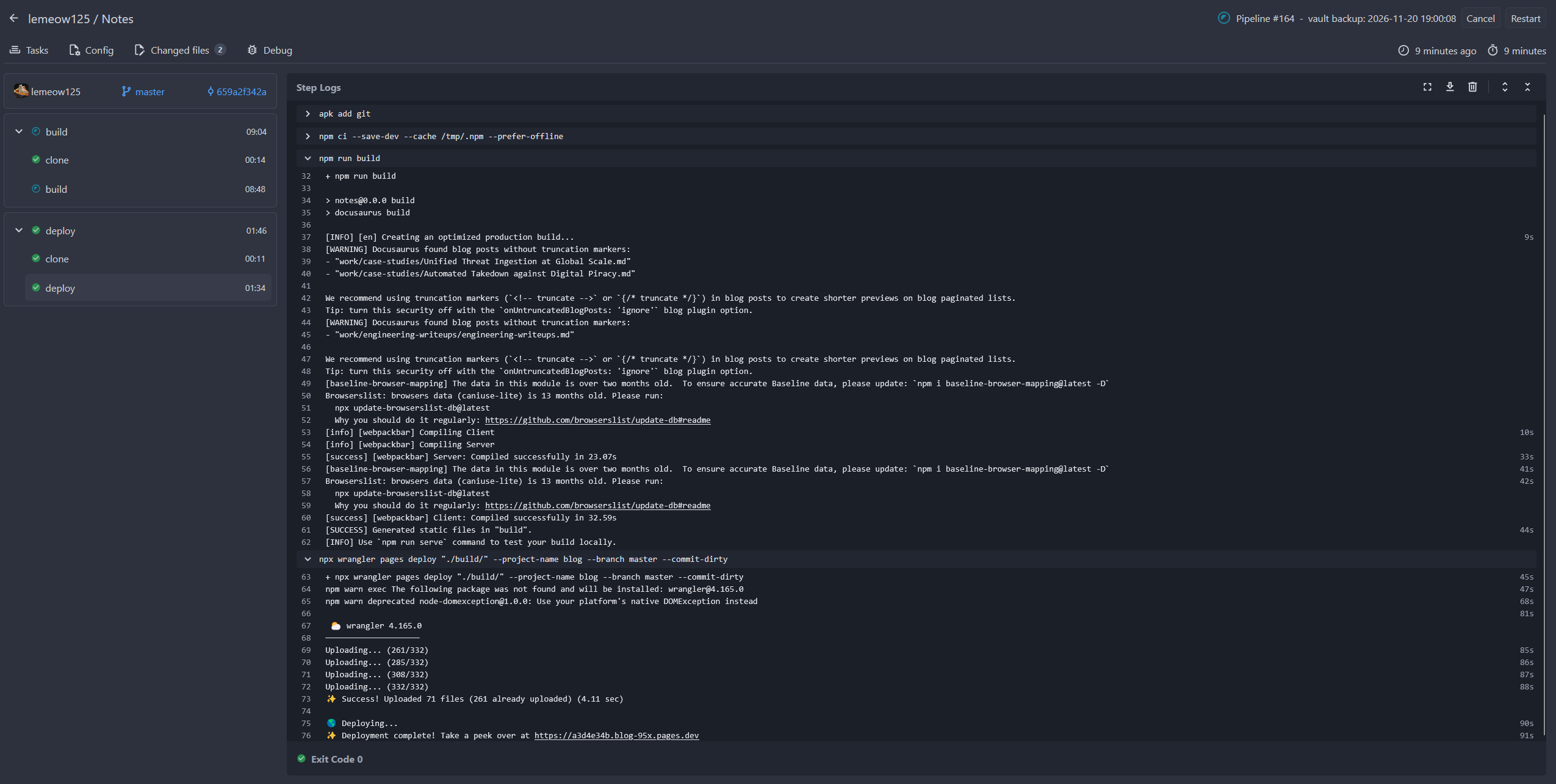
- CI/CD for Personal Notes (Woodpecker) vs. Manual : Running a self-hosted Woodpecker CI/CD pipeline just to publish personal Markdown notes sounds like an over-engineered "crazy take" on paper. In reality, manually copying files between a private vault and a public blog causes sync fatigue and human error. Automating the filter-and-deploy step meant I could keep writing in one place while letting CI/CD handle the publishing mechanics.
- Static Site Generator (Docusaurus) vs. Dynamic CMS: Building a custom blog or managing a database-backed CMS adds server overhead and maintenance for fundamentally static content. Docusaurus let me keep my Markdown-first workflow while unlocking full-text search, structured sidebars, and clean typography.
- Edge Static Hosting (Cloudflare Pages) vs. Self-Hosted Web Servers: While I wanted full control over the build pipeline via self-hosted Woodpecker, running a self-hosted web server just to serve static HTML was unnecessary drag. Pushing the compiled frontend to Cloudflare Pages gave me global CDN edge caching and zero runtime server maintenance.
- Pure Documentation vs. Narrative Storytelling: Standard documentation layouts work well for tactical guides, but they don't showcase strategic impact. Expanding the site's information architecture to separate guides/docs from engineering write-ups and case studies gave peers and engineering leaders clear, dedicated paths to explore my work.
Execution
Rather than abandoning my Markdown habit for a traditional blogging platform, I wrapped my existing notes repository in a full software delivery lifecycle:
- Public/Private Vault Partitioning: Divided my personal Markdown knowledge base into strict public and private boundaries—keeping rough scratchpads, credentials, and proprietary work notes private while flagging polished guides for public release.
- Automated Note Publishing via Self-Hosted Woodpecker CI/CD: Configured a self-hosted Woodpecker CI/CD pipeline triggered on Git commits to automatically extract the public note subset, compile the Docusaurus frontend, verify broken links/builds, and push artifacts directly to production.
- Zero-Server Edge Delivery on Cloudflare Pages: Deployed the compiled static frontend to Cloudflare Pages, decoupling my self-hosted build infrastructure from globally distributed, zero-maintenance public serving.
- Multi-Format Content Architecture: Evolved the site beyond reference documentation to house dedicated sections for engineering write-ups and non-technical case studies (including the page you are reading right now), turning daily engineering work into visible proof of craft.
Impact
- Zero-Friction "Commit-to-Publish" Workflow: Turned personal note-taking into an automated publishing engine—committing a Markdown note triggers Woodpecker CI to build and deploy straight to Cloudflare's edge with zero manual file juggling.
- Safe Public/Private Isolation: Maintained strict separation between private working notes and public content inside a single, cohesive workflow without risking accidental data exposure.
- Controlled Builds, Zero-Maintenance Serving: Paired full pipeline customization on self-hosted Woodpecker with fast, globally cached frontend delivery on Cloudflare Pages.
- Scalable Visibility & Personal Brand: Transformed years of behind-the-scenes engineering notes into a structured, searchable portfolio of guides, engineering write-ups, and case studies.